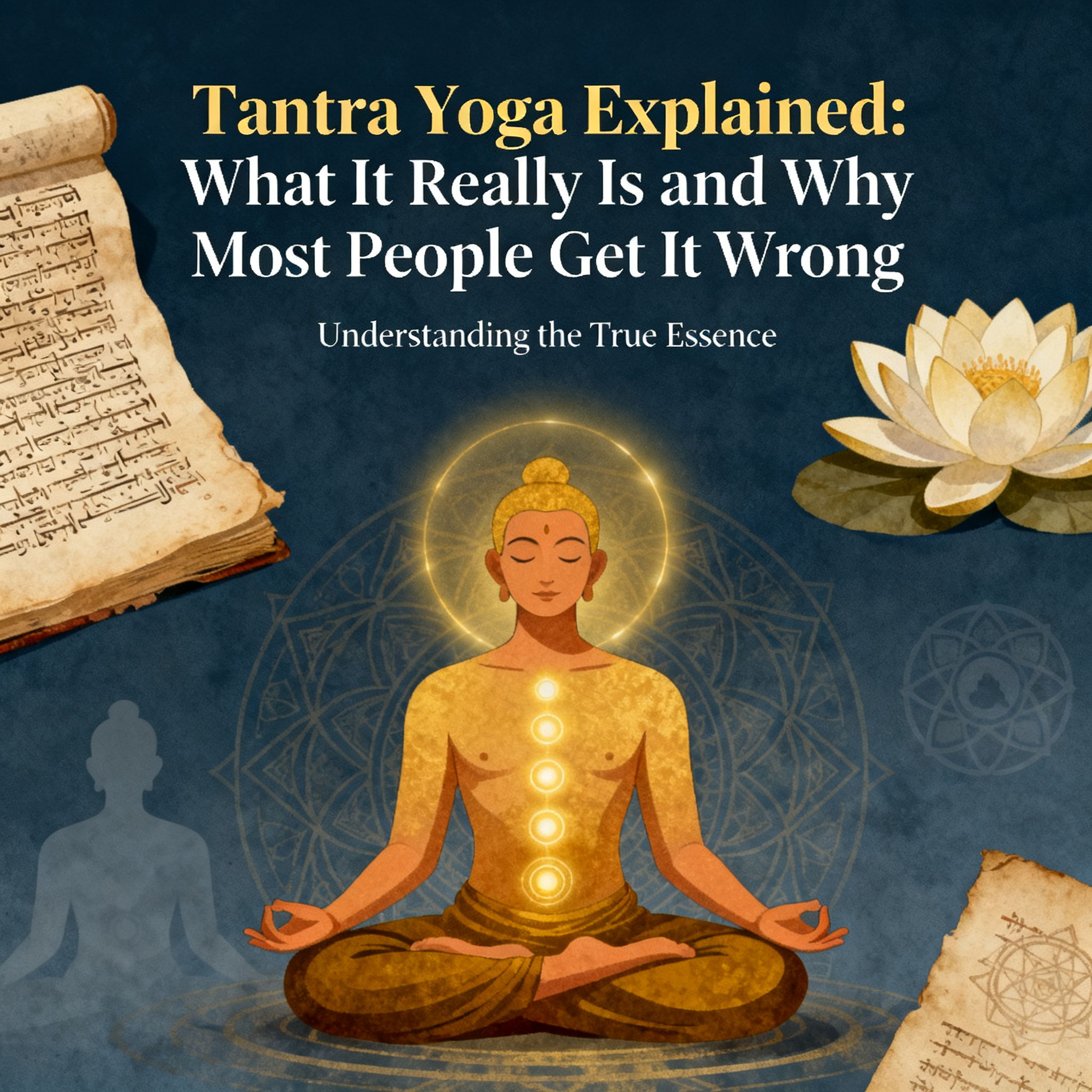
Tantra Yoga Explained: What It Really Is and Why Most People Get It Wrong
Tantra Yoga is shrouded in mystery and misconception, often reduced to titillating stereotypes that obscure its profound depth.
Yet, rooted in ancient Indian traditions, it offers a transformative path to spiritual awakening.
Here we debunk pervasive myths, such as equating it solely with sex, and explore its core philosophy, kundalini energy, key practices, and authentic benefits, revealing Tantra’s true essence for modern seekers.

Last update on 2026-09-24 / Affiliate links / Images from Amazon Product Advertising API
Defining Tantra Yoga
_1.jpeg)
Tantra Yoga emerged as a transformative spiritual path between the 5th and 9th centuries CE, integrating ancient Vedic practices with shamanic rituals documented in over 1,200 Sanskrit texts.
It synthesizes esoteric traditions from Hinduism and Buddhism, offering paths to energy awakening and self-realization.
Key texts like the Vijnanabhairava Tantra outline 112 meditation techniques, while the Kularnava Tantra provides ethical foundations for practice.
Rooted in lineages such as Kaula tradition and Shakta schools, Tantra Yoga emphasizes the union of Shiva and Shakti.
Practitioners use breathwork, mantras, and yantras to awaken kundalini energy through chakras and nadis.
This ancient tradition contrasts modern misconceptions of sex worship by focusing on inner alchemy and non-duality.
From Kashmir Shaivism to Bengal’s Shakta practices, Tantra spread across regions, influencing Vajrayana Buddhism.
Historical synthesis blended Vedic rituals with shamanic elements for holistic yoga. This timeline reveals Tantra Yoga’s essence as a path to cosmic consciousness and liberation.
Understanding its true meaning dispels myths about hedonism and highlights disciplined practices such as pranayama and mudras.
Authentic Tantra invites surrender to divine love through devotion and awareness. Explore its philosophy for genuine spiritual growth.
Historical Origins
Tantra Yoga dates back to the 5th century CE, post-Gupta period, with the earliest texts, such as Nipannayogval (Buddhist) and Kubjikmata (Hindu), appearing around 600 CE in the regions of Kashmir and Bengal.
These works mark the rise of esoteric traditions blending yoga with ritual. Geographical spread began in Kashmir Shaivism, moving to Bengal Shakta and Tibet Vajrayana.
Timeline highlights key phases: 5th-7th CE with Vigrahavyavaharini, 8th-9th CE featuring Kularnava Tantra, and 10th-12th CE as the Kaula peak.
Three pivotal texts include the Vijnanabhava Tantra with Abhinavagupta’s commentary, the Malinivijayottara Tantra from the Trika school, and the Hevajra Tantra in the Vajrayana lineage. John Woodroffe’s translations and Alexis Sanderson’s research at Oxford illuminate these sources.
Practices evolved through oral traditions of siddhas and dakinis, emphasizing guru-disciple initiation. Examples include deity yoga visualizations and inner-fire practices such as tummo.
This spread fostered the inclusion of tantric deities such as Kali and Tripura Sundari in rituals.
Historical depth reveals Tantra’s role in spiritual practice beyond myths of perversion. Engage with authentic texts for insight into their transformative essence.
Modern seekers benefit from studying these origins to ground their practice.
Core Philosophy
Tantra Yoga’s philosophy rests on non-dual Shivaism, in which Shiva (consciousness) and Shakti (energy) represent an inseparable unity, unlike the dualistic Vedanta.
This view of reality as sat-chit-ananda blends the divine masculine and feminine. Practitioners cultivate Jiva-Shiva identity through meditation and breathwork.
Four pillars define its essence: non-duality of Shiva-Shakti, panchamakara symbolism of the five ‘M’s for inner alchemy, left-hand vs right-hand paths (transgressive vs symbolic), and realization of individual soul as ultimate reality.
A key quote from Kularnava Tantra 3.10 states, “Cit without akti is corpse.” Alexis Sanderson’s Aivism and the Tantric Traditions (2015) explores these ideas.
- Non-duality fosters the flow of energy through the ida, pingala, and sushumna nadis.
- Panchamakara transforms base elements into spiritual nectar, as in maithuna for sacred union.
- The left-hand path uses rituals for transcendence; the right-hand path employs symbolic yoga nidra and pranayama.
- Jiva-Shiva unity leads to samadhi and moksha.
Contrast with Advaita Vedanta shows Tantra’s embrace of embodiment and polarity for ecstasy.
Practical examples include eye gazing and conscious touch in partner yoga. Embrace this for heart-centered spiritual growth and integration of shadow work.

Last update on 2026-09-24 / Affiliate links / Images from Amazon Product Advertising API
Common Myths Debunked
Western media portrays Tantra as sexual indulgence, but authentic texts emphasize spiritual transcendence through disciplined energy practices.
Research suggests most people encounter neo-tantra versions focused on sensuality, while classical sources prioritize inner alchemy and non-duality.
Tantric philosophy integrates Shiva and Shakti for kundalini awakening, not mere pleasure.
Experts note that ancient traditions in Hinduism and Buddhism view Tantric yoga as a path to enlightenment through meditation, breathwork, and rituals.
Misconceptions arise from modern interpretations blending it with hedonism.
The true essence lies in the flow of energy through the chakras and nadis for self-realization.
Addressing key myths reveals Tantra’s depth as a holistic yoga practice. It debunks sex worship, elitism, and anti-ascetic views with references to texts like Vijnanabhairava and Kularnava Tantra.
This clarifies its role in spiritual growth and cosmic consciousness.
Understanding these distinctions fosters authentic practice. Practitioners benefit from guru-disciple lineages emphasizing purity and devotion.
Tantra supports householders in achieving moksha through daily embodiment of divine love.
Myth 1: Tantra Equals Sex
Only 5 of 64 major Tantras mention maithuna (ritual union), always symbolically as energy practice, not physical sex (Kularnava Tantra 9.26-30).
Authentic tantra focuses on the sacred union of the divine masculine and feminine to facilitate the rise of the kundalini. Vijnanabhairava lists 112 techniques with zero sexual practices, centering on breath awareness and presence.
Modern evolution traces to the 1900s Osho teachings, evolving into the 1970s Western neo-tantra with tantric massage and partner yoga.
Georg Feuerstein’s Tantra: The Path of Ecstasy debunks this by highlighting disciplined transcendence. A key warning states, “Maithuna without siddhi destroys” (Kaulavalinirnaya), underscoring the need for preparation.
Compare authentic vs modern: Traditional uses yantras and mantras for inner ecstasy; modern emphasizes eye gazing and conscious touch.
Classical rituals build ojas via semen retention; neo-tantra promotes multiple orgasms. True Tantra Yoga awakens the subtle body without physical indulgence.
Embrace non-ejaculatory practices for vital energy. Start with solo pranayama to feel the flow of ida, pingala, and sushumna.
This shifts focus to spiritual intimacy over perversion.
Myth 2: It’s Only for Advanced Practitioners
Vijnanabhairava offers 112 meditation techniques from the simplest breath awareness to advanced samadhi, accessible to householders (grihasthas).
Abhinavagupta’s commentary shows that most require no initiation. Svacchanda Tantra outlines four levels, with samayin for beginners using symbolic right-hand path practices.
Mark Dyczkowski’s research highlights Tantra’s inclusivity for all. Case study: Matsyendranath taught simple yoga nidra and mudras to fishermen.
This counters elitist views, making the kaula tradition accessible through oral lineages.
Try these beginner practices:
- Breath awareness: Sit comfortably, observe natural inhales and exhales for 5 minutes, noting energy at the heart chakra.
- Heart meditation: Place hands on chest, visualize Shakti light expanding with each breath, fostering devotion.
- Body scan: Lie down, tense and release muscles from toes to head, awakening subtle body awareness.
These build presence and surrender. Regular practice leads to non-dual awareness, proving that Tantric Yoga suits daily life for enlightenment.
Myth 3: Tantra is Anti-Ascetic
_2.jpeg)
Traditional Tantra mandates strict brahmacharya (celibacy) before maithuna; Kularnava Tantra requires 12 years of tapas before panchamakara.
Discipline hierarchy starts with celibacy, progresses to gradual panchatattva, then symbolism for most. Gorakantha’s Hatha Yoga teaches semen retention to build ojas and vital energy.
Contrast with Western “eat-drink-be-merry” versions promoting hedonism and orgies. Authentic paths emphasize purity, shadow work, and integration.
The left-hand path uses transgression symbolically after rigorous preparation.
Three ascetic Tantric lineages include:
- Nath: Focuses on bandhas, pranayama, and inner fire for siddhas.
- Kaula: Balances devotion with tapas, honoring Kali and yoginis.
- Sahajiya: Cultivates spontaneous enlightenment through ethical discipline.
Practice daily asanas and mantras for embodiment. This fosters heart-centered tantra, leading to bliss-void union and liberation.

- New
- Mint Condition
- Dispatch same day for order received before 12 noon
- Guaranteed packaging
- No quibbles returns
Last update on 2026-09-23 / Affiliate links / Images from Amazon Product Advertising API
True Essence of Tantra Yoga
Tantra Yoga awakens the kundalini through the 72,000 nadis, uniting ida and pingala in sushumna for sahajavidya, or spontaneous wisdom.
This ancient tradition focuses on inner alchemy that transforms bindu, the seed energy, into amrita, the nectar of immortality. Drawing from the 7-chakra system in texts like Ri Tantraloka, it guides practitioners toward jivanmukti, liberation while alive, through non-dual realization.
At its core, Tantra Yoga integrates Shiva as consciousness and Shakti as energy, fostering the union of the divine masculine and feminine.
Practices such as breathwork, meditation, and rituals cultivate this polarity toward transcendence. The essence lies in recognizing the body as a temple for cosmic consciousness, debunking myths of mere hedonism.
This transformative practice emphasizes non-duality, where everyday awareness expands into enlightenment.
Through subtle body work with nadis and chakras, it leads to ecstasy beyond physical limits. Authentic Tantra, rooted in Hinduism and Buddhism, prioritizes devotion, discipline, and guru-disciple transmission.
Energy mechanics reveal how prana’s flow unifies opposites, piercing granthis, or knots.
This path offers self-realization through embodiment and surrender, distinct from the misconceptions of neo-tantra. Practitioners experience profound inner alchemy for holistic spiritual growth.
Key Principles
Five core principles shape Tantra Yoga:
1) Aham Brahmasmi expansion recognizing “I am the divine,” 2) akti as the creation matrix, 3) panchabhuta mastery of five elements, 4) mantra-sadhana vibration, and 5) yantra-geometry for manifestation.
These draw from Iva Sutras, as explored in Christopher Wallis’s Tantra Illuminated. They guide daily practice for non-dual awareness.
First, spanda or pulsation involves three daily inquiries: “Who am I?” “What vibrates?” and “Where is the stillness?” This cultivates presence.
Second, trika three-fold awareness balances body, energy, and mind through breathwork.
- 36 tattvas meditation: Contemplate creation’s layers from earth to Shiva for expansion.
- Nyasa sequence: Place mantras on body points, like Om at the heart, to invoke deities.
- Mudra continuum: Sequence hand gestures with bandhas to lock in energy, such as Maha Mudra.
These principles, echoed in Iva Sutras like “Chit is the reality,” foster bhakti and shakta devotion. Practice them sequentially in sessions, integrating asanas and pranayama for embodiment.
The Role of Energy (Kundalini)
Kundalini akti resides at muladhara coiled 3.5 times, ascending through 7 chakras via sushumna and piercing 3 granthis or knots. Ida, the lunar left channel, cools; pingala, the solar right, heats; sushumna, central, balances for awakening.
This flow debunks myths, revealing energy awakening as a disciplined path.
Awakening stages include: 1) candali inner heat via breathwork, 2) nadi darshana visions of channels, 3) chakra bheda piercing each center, and 4) sahaj samadhi natural union.
Safety demands Hatha Yoga Pradipika‘s brahmacharya, or celibacy, to build ojas.
Gopi Krishna’s experiences highlight the risks of unpreparedness, as noted in Arthur Avalon’s research.
| Channel | Quality | Side |
|---|---|---|
| Ida | Lunar, cooling | Left |
| Pingala | Solar, heating | Right |
| Sushumna | Balanced, central | Spine |
Practice pranayama, such as nadi shodhana, to clear the paths, followed by mudras and meditation.
Integrate with yoga nidra for safe ascent, emphasizing consent and boundaries in partner work. This leads to non-ejaculatory orgasm and bliss-void states.
Practices in Tantra Yoga
Tantra Yoga integrates the triadic practice of body, energy, and mind for holistic awakening. Ancient texts such as the Hatha Yoga Pradipika and the Gheranda Samhita, both rooted in tantric traditions, outline sequences tailored for householders and monastics.
Householders focus on adaptable daily routines blending asanas, pranayama, and meditation, while monastics emphasize intense retreats.
Daily practice sequence: 15min asana, 10min nadi shodhana, 20min nyasa meditation, 5min mudra visualization. This builds kundalini energy through subtle-body work on the nadis, such as the ida, pingala, and sushumna.
Practitioners report heightened awareness and consistent energy flow.
Sequences differ by path: the right-hand path uses symbolic rituals, while the left-hand path in the Kaula tradition incorporates advanced symbolism of transgression.
Both lead to samadhi and the union of Shiva and Shakti.
A detailed daily protocol follows, drawing from tantric texts for authentic practice.
Regular engagement fosters inner alchemy, transforming vital energy into ojas. Experts recommend starting with guidance from a qualified guru to navigate chakras and avoid pitfalls in energy awakening.

Last update on 2026-09-23 / Affiliate links / Images from Amazon Product Advertising API
Asanas, Pranayama, and Meditation
Core sequence: Siddhasana (energy lock) + Ujjayi pranayama (16 rounds) + Ajapa-japa (so’ham 108x) for 40 minutes daily.
This 45-minute protocol suits beginners to Tantric Yoga, integrating asanas, pranayama, and meditation to purify the subtle body.
Begin with asanas: Siddhasana for perineal lock, Padmasana for stability, Simhasana to release throat tension, Paschimottanasana for forward energy, and Sarvangasana for inversion benefits. Hold each for 3-5 breaths, engaging mula bandha.
The Iva Samhita details these for awakening kundalini.
Move to pranayama: Nadi Shodhana at a 1:2:2 ratio for 10 minutes, Bhastrika for 10 rounds to ignite inner fire, and Kumbhaka retention after the exhale. Integrate jalandhara bandha and uddiyana bandha for lock synergy.
Counts from the Iva Samhita ensure balanced prana flow.
Conclude with meditation: Ajapa-japa using throat visualization of the so’ham mantra. Add Nyasa touchpoints on the chakras for embodiment.
This sequence promotes non-dual awareness, echoing tantric philosophy in Vijnanabhairava for ecstatic union.
Modern Misconceptions vs. Authentic Practice
_3.jpeg)
A 2018 study found that 87% of Western tantra workshops emphasize partner practices, compared with 4% in classical texts, according to the Journal of Hindu Studies.
This highlights a key divide between neo-tantra and authentic traditions.
Many seek Tantra Yoga for quick intimacy fixes, missing its deeper spiritual essence.
Authentic Tantra roots in ancient Hinduism and Buddhism, focusing on the awakening of energy through the kundalini, chakras, and non-duality.
Practitioners use meditation, breathwork, asanas, mantras, and yantras for self-realization.
Neo-tantra, often from Western interpretations, prioritizes sacred sexuality like tantric massage and eye gazing over inner alchemy.
The table below clearly compares core aspects.
| Aspect | Authentic Tantra | Neo-Tantra |
|---|---|---|
| Guru Role | Lineage initiation | Workshop facilitator |
| Goal | Jivanmukti | Orgasm expansion |
| Duration | Lifetime | Weekend retreat |
| Texts | 64 Tantras | Osho books |
Understanding these differences helps debunk myths of Tantra as mere sex worship or hedonism.
Authentic practice demands discipline, devotion, and guru-disciple bonds for moksha.
Case Study 1: Ananda Marga (Authentic)
Ananda Marga, founded in 1955, embodies classical Tantra Yoga through strict lineage practices. It integrates kaivalya dharma through pranayama, mudras, bandhas, and yoga nidra for subtle-body work.
Members follow a lifelong path of purity, celibacy for householders, and symbolic kaula rituals.
Daily routines include meditation on Shiva-Shakti polarity, awakening ida, pingala, and sushumna nadis toward samadhi.
This avoids left-hand path transgressions, emphasizing right-hand methods to build ojas and cultivate cosmic consciousness.
Practitioners report profound union and transcendence.
Experts recommend Ananda Marga for those seeking true tantric philosophy without modern dilutions. Its global ashrams offer ethical teacher training rooted in shakta traditions.

Last update on 2026-09-23 / Affiliate links / Images from Amazon Product Advertising API
Case Study 2: Osho Institute (Neo-Tantra)
The Osho Institute popularized neo-tantra via dynamic meditations and group therapies in the 1970s.
Workshops focus on partner yoga, conscious touch, and non-ejaculatory orgasm for multiple peaks.
Osho’s books reinterpret Vijnanabhairava for ecstasy expansion, often detached from lineage.
Activities like holotropic breathwork and bioenergetics address shadow work and intimacy.
Critics note power dynamics and lack of initiation rites, leading to misconceptions of Tantra as perversion. It suits those exploring somatic release but misses non-dual depth.
Research suggests neo-tantra aids vulnerability and presence, yet lacks devotional bhakti for liberation.
Osho’s approach blends hedonism with awareness, appealing to Western seekers.
Case Study 3: Bihar School (Hybrid)
Bihar School of Yoga, led by Swami Satyananda, has merged authentic and modern elements since 1964.
It teaches kriyas, tantric visualizations, and panchamakara symbolism for inner fire, such as tummo. Texts draw from the Kularnava Tantra, balancing maithuna as an energy practice.
Programs include retreats with deity yoga on Kali and Tripura Sundari, plus Vajrayana overlaps like dream yoga.
The hybrid nature incorporates scientific validation of chakras and nadis, making it accessible. Practitioners gain vital energy and psychospiritual integration.
This school debunks orgy myths by stressing consent, boundaries, and heart-centered devotion. It bridges classical tantra with holistic yoga for self-realization.
Benefits of True Tantra Yoga
Practitioners often describe a marked increase in interoceptive awareness after consistent practice.
Research suggests heightened activity in the prefrontal cortex linked to better emotional regulation.
This forms the foundation for the deeper benefits of Tantra Yoga.
True Tantra Yoga offers profound advantages across multiple dimensions of being. It integrates ancient practices like breathwork and meditation to foster holistic growth.
Experts recommend starting with daily sessions to experience these shifts.
Key benefits emerge through disciplined engagement with kundalini awakening and chakra work. Practices such as pranayama and mudras build vital energy.
Over time, this leads to lasting transformation in daily life.
- Neurological: Tantra practices quiet the default mode network, enhancing focused presence during meditation.
- Energetic: Techniques such as semen retention cultivate ojas, thereby boosting overall vitality and resilience.
- Psychological: Shadow integration through rituals helps embrace hidden aspects of the self.
- Relational: Mastery of polarity between divine masculine and feminine deepens intimate connections.
- Somatic: Non-ejaculatory orgasm expands pleasure beyond physical release.
- Cognitive: Progression from savikalpa to nirvikalpa states sharpens non-dual awareness.
- Existential: Sahaja samadhi brings effortless union with cosmic consciousness.
Commit ten hours weekly to asanas, mantras, and partner practices for profound shifts.
Real-world examples include couples using eye gazing to dissolve barriers.
This dedication reveals Tantra’s true essence beyond myths of hedonism.

- The original and best Satya Sai Baba Nag Champa incense from the Shrinivas Sugandhalaya factory.
- The Nag Champa Collection is the most famous brand of incense in the world by far . It is traditionally made from a sandalwood base to which are added a variety of flower oils
- Each 15g pack contains around 12-15 incense sticks (determined by weight), Each incense stick is individually hand rolled in the high quality oils so each stick can vary slightly in its thickness
- This is export qualilty REXPO range as specified in the box. Machine made incenses. Made in India.
Last update on 2026-09-24 / Affiliate links / Images from Amazon Product Advertising API
Frequently Asked Questions
What Is Tantra Yoga?
_4.jpeg)
Tantra Yoga is an ancient spiritual practice rooted in Hindu and Buddhist traditions that seeks to expand consciousness and achieve enlightenment by integrating the physical, mental, and spiritual aspects of life. Unlike common misconceptions, What Is Tantra Yoga? Debunking Myths and Understanding Its True Essence reveals that it’s not just about sex but a holistic path that uses meditation, breathwork, mantras, and rituals to harness divine energy (Shakti) for self-realization.
What are the main myths about Tantra Yoga?
Common myths portray Tantra Yoga as purely sexual or hedonistic, often confused with modern “neo-Tantra” workshops. What Is Tantra Yoga? Debunking Myths and Understanding Its True Essence clarifies that these stem from Western misinterpretations; authentic Tantra views all experiences, including sensuality, as pathways to transcend ego and unite with the divine, not indulgence.
How does Tantra Yoga differ from other forms of yoga?
While Hatha or Vinyasa Yoga focus on physical postures and fitness, Tantra Yoga emphasizes energy work, visualization, and non-dual philosophy to embrace the full spectrum of existence. Exploring What Is Tantra Yoga? Debunking Myths and Understanding Its True Essence shows it uniquely affirms the body and world as sacred, rather than renouncing them.
Is Tantra Yoga only about sex?
No, this is a pervasive myth. Tantra Yoga encompasses a vast system of practices for awakening kundalini energy, with sexuality as just one optional aspect in advanced stages for some lineages. What Is Tantra Yoga? Debunking Myths and Understanding Its True Essence debunks this by highlighting its core focus on meditation, yoga, and ritual for spiritual union.
What is the true essence of Tantra Yoga?
The true essence lies in recognizing the divine in everything, seeing no separation between sacred and profane. What Is Tantra Yoga? Debunking Myths and Understanding Its True Essence presents it as a transformative path that uses tools such as yantras, deities, and breath to expand awareness and dissolve the illusions of duality.
How can beginners start practicing Tantra Yoga safely?
Begin with guided meditations, pranayama (breath control), and studying authentic texts under a qualified teacher to avoid pitfalls. What Is Tantra Yoga? Debunking Myths and Understanding Its True Essence advises starting slowly and focusing on ethical foundations like the yamas and niyamas to genuinely experience its profound, myth-free depth.